
How to Talk to Your Child’s Teacher Without Being THAT Parent
At a Glance
- It’s important to have effective communication between a parent and a teacher
- Parents should establish a rapport early on in the year
- Parents should be respectful of a teacher’s time and approach them directly with openness
When my son was in elementary school, one of his classmates’ parents seemed to have a dire need to speak with the teacher at dismissal every day. The teacher was as gracious as she could possibly be, at least from what I observed, but I could tell this parent was grinding on her last nerve.
One day, the parent chatted me up while we were waiting for our kids to come out. She complained about the difficulty of the math homework, and while I agreed it was tough – my son was having his own troubles with it – she went on to complain about the teacher (who likely did not create the curriculum in the first place). Moments later, the class appeared and she made a beeline straight for the teacher. I shook my head and decided to save my own math inquiries for the upcoming parent teacher conference.
While I understand the importance of advocating for your child, there is a time and a place for it. I never forgot that parent and always wondered if her incessant demands of the teacher worked out negatively for her child. To be honest, after witnessing her daily display of entitlement, I never wanted to approach a teacher at dismissal again. I stuck to emails, mostly. But I always wondered where the line is drawn between a parent/teacher relationship when it comes to communication. I never, ever want to be THAT parent.
I spoke with Anne Josephson, Psy.D., M.S. Ed., clinical psychologist and the owner of NYC-based Uptown Psychology, as well as a former special education teacher and school psychologist, to get a better picture of an effective dynamic between parents and teachers.
Psst… Check Out Gov. Hochul Announces 2-Care: Free Child Care for 2-Year-Olds in New York
Me: How can a parent secure a good relationship with a teacher?
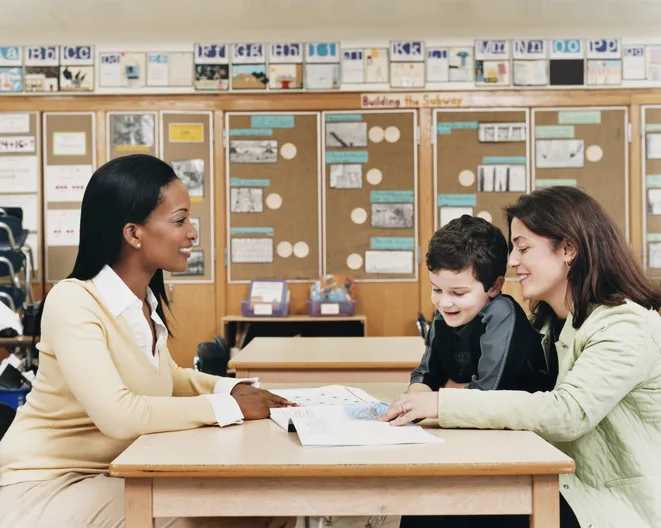
Anne: A strong parent–teacher relationship begins early in the school year. Introducing yourself, expressing openness, and interest in the teacher’s approach helps to establish rapport. Trust develops over time, but parents can set a positive tone when they assume the teacher is coming from a good place. Additionally, respect for the teacher’s role is helpful in building a warm parent-teacher relationship.
Parents make thoughtful choices about the schools their children attend. Part of that trust extends to believing the school has hired capable, caring educators. I often remind families that people enter teaching because they genuinely care about children and want to support their growth. Starting from this shared purpose helps build a collaborative relationship.
Me: When are appropriate and inappropriate times to approach a teacher?
Anne: It is best to approach a teacher when they appear both physically and emotionally available for conversation. Parents often try to use drop-off or pick-up because the timing feels easy and convenient. However, these are typically high-demand times for teachers. They are managing transitions, attending to student safety, and preparing for the start or end of the day. Unless the message is a quick reminder, it is difficult for teachers to offer the attention a meaningful conversation requires.
A better approach is to briefly let the teacher know during drop-off or pick-up that you would like to schedule time to talk and possibly a little bit about what you would like to speak about. Example, “I’m going to send you an email to discuss strategies for transitioning to school.” This sets the stage for a calm, productive discussion. A follow-up email outlining what you’d like to address, as well as your availability, is best. Most teachers can fit in a short meeting before school, after school, or during a designated prep period.
Me: When a parent is upset with something that happened in the classroom, how should they go about speaking to the teacher?
Anne: When something upsetting occurs, I encourage parents to go directly (and respectfully) to the teacher before involving other professionals. While it may feel uncomfortable, speaking to the teacher first allows them to provide context and answer any questions you may have. Starting the conversation from a place of assuming the best helps reduce defensiveness and creates space for honest communication.
Teachers take their responsibility seriously and approaching them with openness typically leads to much more productive outcomes. It also models to our children that we are working as a team. During the school year, your child’s teacher is spending more time with them than you. In many ways they are an extension of your family for that period of time, and we should do our best to treat it as that. Last week, I felt frustrated as a parent when my child had an accident at school, and no one called me, but rather shared this with a babysitter. The next day, when going through my school’s app, I found a whole note from the teacher about the fall. While I really appreciate her sharing this information with me, I intend to ask her to call or text me with anything related to injuries so that I am able to see it faster.
Anne’s Do’s and Don’ts for Communicating with Teachers
Do:
• Ask before assuming
• Communicate to teachers that you trust them, and respect them as experts
• Stand up for your child while remaining respectful.
• Recognize teachers as experts in child development and instruction
• Include teachers in the process
• Be honest about what is going on at home
Don’t:
• Undermine the teacher in front of your child.
• Assume you know what happened without asking
• Immediately escalate concerns above the teacher before speaking with them directly
Psst… Check out How to Nail Co-Parenting With Your Ex